Mortgage Rate Mix
More homeowners hold above-6% mortgages as demand stays fragile amid storms.
Feb 8th, 2026
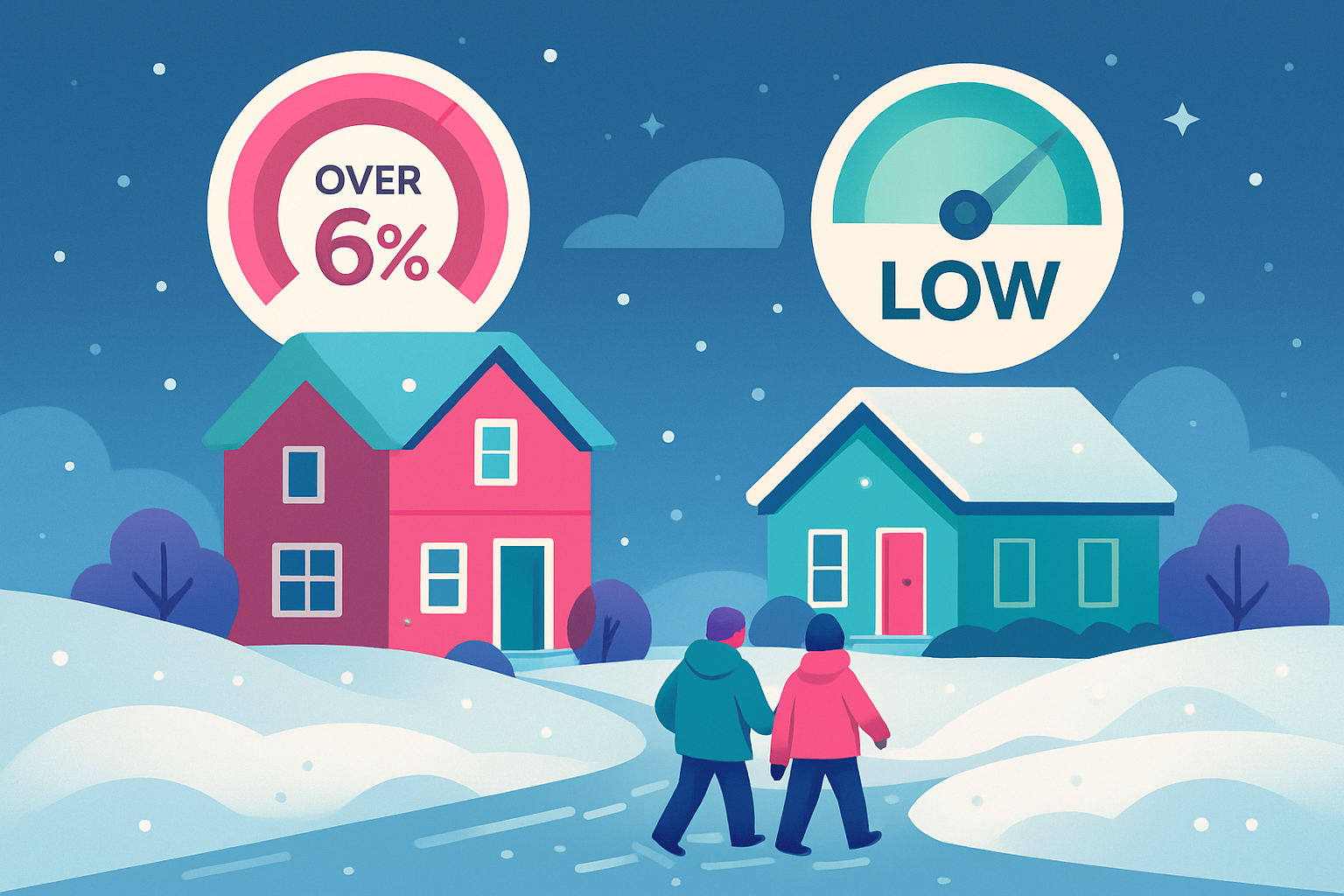
A quiet but consequential shift is unfolding in U.S. housing finance: a meaningful share of homeowners now carry mortgages that would have looked unusually pricey just a few years ago. At the same time, the market’s day-to-day momentum remains delicate, with even a slight dip in rates failing to ignite a buying rush when severe weather keeps shoppers off the roads. Together, these developments show how today’s housing market is being shaped not only by where rates sit, but by who holds which rates—and how easily activity can stall.
A growing pocket of homeowners above 6%
Roughly one in five U.S. mortgage borrowers now has an interest rate above 6%, a striking departure from the ultra-low-rate era that still looms large in recent memory. That share has climbed quickly over the past few years, tracking the broader reset in borrowing costs after a long stretch of cheap money.
This matters because mortgage rates don’t just steer new buyers; they also influence how current owners make decisions. When a sizable cohort is paying above 6%, their incentives aren’t the same as those locked into much lower rates. Some may feel more strain from monthly payments, while others may be quicker to consider refinancing if rates ever fall far enough to make the math work. Either way, the spread of rates across households is becoming a central part of the story—not just the headline average.
Why the rate “mix” changes market behavior
When homeowners are scattered across different rate levels, the market can react in uneven, sometimes contradictory ways. Owners with very low rates often hesitate to move because replacing their mortgage would likely cost more, even if they want a different home. Meanwhile, owners with higher rates may be more inclined to act if they see a realistic path to lowering their payment—but only if rates drop enough to make refinancing worthwhile.
That creates a market constrained from multiple directions at once. Higher rates can squeeze affordability for buyers, while the legacy of low-rate mortgages can shrink the pool of would-be sellers willing to give up their existing financing. The presence of a meaningful group above 6% adds another wrinkle: not everyone is “locked in” at the same level, and the pressure points are shifting.
Mortgage demand falls despite slightly lower rates
In the latest weekly snapshot of mortgage activity, demand fell sharply even as interest rates edged down. It’s a reminder that rates, while critical, aren’t the only force shaping near-term behavior. A small move lower may not materially improve affordability, and it may not be compelling enough to draw hesitant buyers off the sidelines.
The drop also underscores how sensitive the market remains after an extended period of higher borrowing costs. When households are already cautious, it can take more than a marginal improvement in rates to restore momentum.
Weather as an underappreciated market force
The immediate driver behind the weekly decline in mortgage demand appears to have been winter storm Fern. Severe weather can disrupt the housing market in straightforward ways: showings get canceled, travel becomes risky, and buyers postpone decisions. Even if financing conditions improve slightly, applications can dry up quickly when people stay home.
This isn’t a structural change, but it’s a revealing stress test. If the market can be thrown off course by a single major storm, it suggests underlying demand isn’t strong enough to push through disruptions. That fragility matters for everyone from agents scheduling open houses to lenders projecting volume.
What this means for buyers right now
For buyers, the takeaway is mixed. A modest rate dip doesn’t automatically translate into a surge of competition, especially when external factors—like severe weather—reduce activity. At the same time, the broader backdrop still reflects financing costs that are higher than many households anticipated, and the market remains highly sensitive to affordability.
Timing can matter in unexpected ways. A week of bad weather may thin out immediate competition, but it can also slow the practical work of touring homes and moving toward an offer. The bigger point is that today’s market can shift quickly for reasons that have little to do with economic fundamentals.
What this means for homeowners and would-be sellers
Homeowners are increasingly split by the rate they hold. With about 20% paying above 6%, there’s a substantial group whose mortgage costs look more like today’s market than yesterday’s. That can shape household budgets and longer-term plans, and it may influence refinancing interest if rates decline.
For potential sellers, the rate they already have remains a decisive factor in whether to list. Even without more detailed breakdowns beyond the share above 6%, it’s clear the market is no longer defined by a single “typical” mortgage experience. Some owners may feel pinned down by the cost of replacing their loan, while others may be less constrained.
Signals to watch as the market heads forward
The latest data points spotlight two themes: the growing importance of rate distribution among existing borrowers, and the vulnerability of demand to short-term disruptions. In the weeks ahead, watch whether mortgage demand rebounds once weather normalizes—and whether rate moves are large enough to change behavior rather than simply lift sentiment.
Given the limited set of recent coverage here, there isn’t enough information to draw firm conclusions about longer-term paths for pricing or inventory. But even these two snapshots—one on the share of borrowers above 6%, and one on storm-driven demand weakness—make the same point: housing activity is being shaped by both the financial legacy of past years and the practical realities of the present.
The housing market often gets reduced to a single number—the average mortgage rate—but the more telling story is who pays what, and how quickly buyers can pause when conditions turn inconvenient. With a meaningful share of homeowners now above 6% and demand proving sensitive to disruptions like winter storm Fern, the market is signaling it’s still searching for stable footing—one rate move, and one canceled showing, at a time.